The Wrong Move
The Wrong Move, 2024
Synopsis
A Wrong Move follows a man who visits an old female friend in her apartment, believing that she needs his help. What begins as an attempt to understand her loneliness and psychological distress gradually turns into a confrontation with his own life.
As fragments of their shared past resurface, the boundary between comfort, memory, affection and dependence becomes increasingly unstable. The conversation shifts from her grief and isolation toward his dissatisfaction with marriage, work and the life he has built for himself.
Originally conceived as a dialogue-driven adaptation, the finished film ultimately became almost silent, leaving behind two people sharing the same room, revisiting a past that neither of them fully understands.
Director’s note
I made A Wrong Move when I was in Grade 9. It was the first film I had ever attempted to make.
The project began with a short novel written by my friend Qiushui, who also played the male protagonist. When I first read it, I was fascinated by its long conversations and immediately began imagining images to accompany them. At that point, however, I had very little understanding of filmmaking. I did not yet know how to translate literature into cinematic language, how to direct performance, or even how dramatically different an imagined scene could become once a camera was placed in front of it.
Although I was credited as the director, looking back, I think my actual contribution was much closer to that of a producer. Qiushui, as both the original writer and actor, carried much of the project’s creative foundation. My role was primarily to make the film happen: bringing people together, finding a location and equipment, organising the shoot, and turning an idea into something that could physically exist in front of a camera.
For that reason, I do not regard A Wrong Move as an early demonstration of my directorial voice. I see it instead as the moment when filmmaking stopped being something I only imagined and became something I actually did.
Its greatest significance to me is very simple: I started.
Production notes
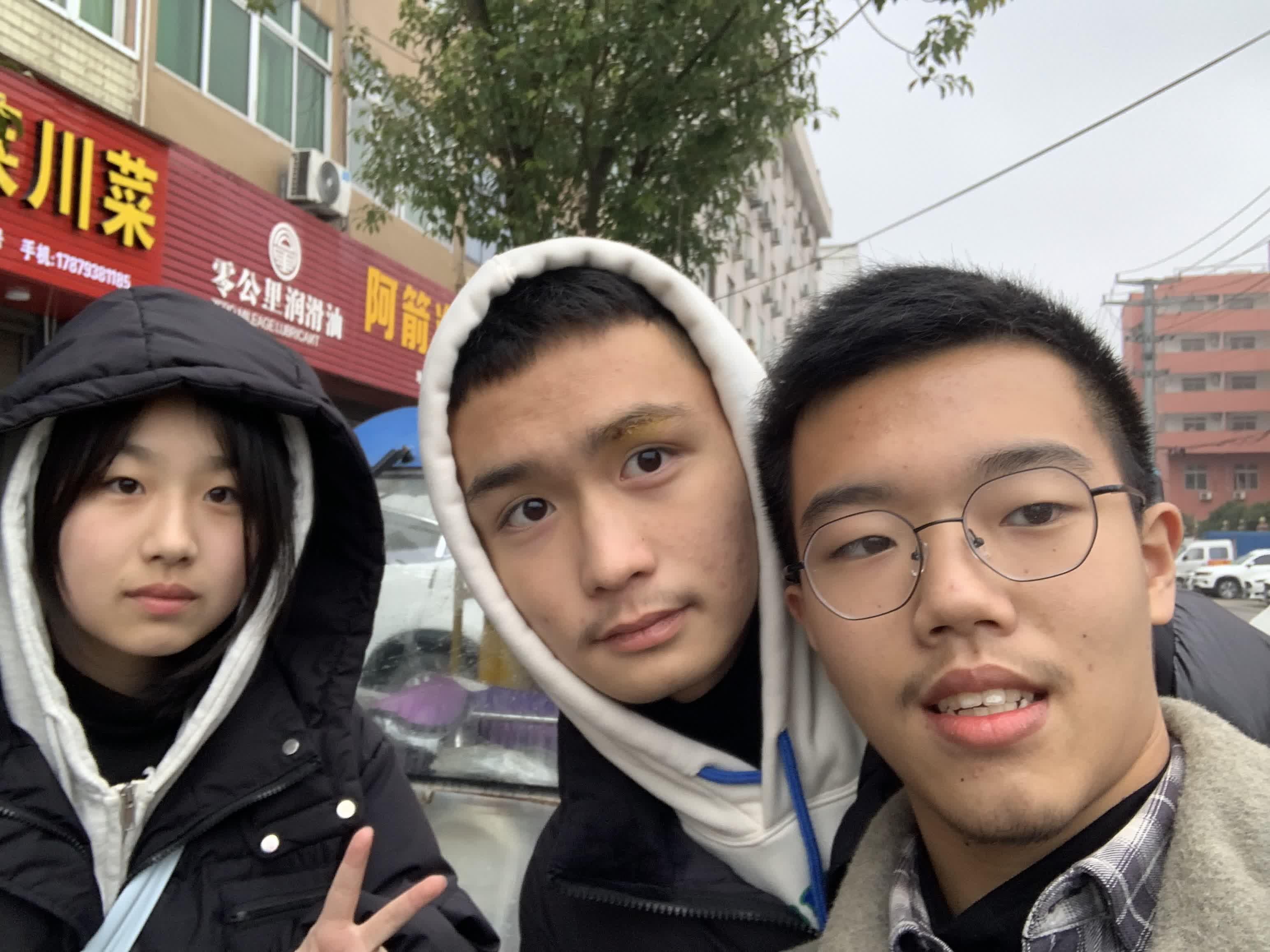
A Wrong Move was made by a four-person team: myself, Qiushui, Zhu Yilin, who played Xizi, and Chen Lingyi.
We shot the entire film in one day inside an apartment in my hometown. There was no professional crew or external guidance, and almost every part of production was new to us.
The technical challenges became immediately apparent. Before this project, I had mostly used an inexpensive DSLR. For the shoot, I was suddenly working with a Sony A7 IV as well as a DJI RS3 gimbal, neither of which I properly knew how to operate. Instead of expanding what I could do, the equipment sometimes became another problem I had to solve while shooting.
Sound was the most serious failure. With limited equipment and almost no experience in location sound recording, we were unable to control environmental noise and unwanted interference. Most of the dialogue recordings were ultimately unusable.
This was particularly damaging because the original story depended heavily on conversation. The exchanges between the two characters were supposed to carry the emotional and intellectual structure of the film. During editing, I eventually made the decision to remove almost all of the recorded dialogue and turn the project into an essentially silent film.
As a result, the completed work became very different from the film we originally intended to make.
Reflection
Looking back at A Wrong Move, I can see how little I understood about cinema at the time.
I had read a dialogue-heavy piece of fiction, imagined several images in my head, and assumed that filming those images would somehow turn the text into a film. I had not yet understood the difference between literature and cinema, or the amount of thought required in performance, blocking, sound, cinematography, rhythm and editing.
The greatest contradiction in the finished work is that the strongest element of the original material was its dialogue, yet the dialogue was precisely what we lost. Because the production sound was almost unusable, the final cut became nearly silent. What remained was essentially a boy and a girl sitting together, moving through a conversation that the audience could no longer hear.
At the time, this felt like a major failure. In many ways, it was.
But I now value the film precisely because it preserves the distance between what I imagined filmmaking to be and what filmmaking actually demanded from me.
I would not try to defend its mistakes by pretending that every accident was an artistic decision. The missing dialogue was not an experiment in silence; it was the consequence of inadequate preparation and technical knowledge. The limited visual language was not minimalism; much of it came from my inability to use the camera and stabiliser confidently.
Recognising that difference has become important to the way I evaluate my own work. A filmmaker can reinterpret an accident, but should not rewrite the history of how it happened.
A Wrong Move is therefore less important to me as a finished film than as a record of my first encounter with the reality of filmmaking.
What I learned
The most important thing I learned from A Wrong Move was that wanting to make a film and knowing how to make one are completely different things.
Before this project, cinema existed largely in my imagination. I could picture scenes, performances and camera movements without having to confront the practical questions behind them. Once production began, every imagined image became a series of decisions: where to place the camera, how an actor should move, how a room should sound, how equipment should be operated, how much could realistically be completed within a day.
I also learned that technical decisions are inseparable from creative ones. Sound recording might appear to be a technical problem, but in this film it fundamentally altered the meaning of the final work. Losing the dialogue meant losing the very element on which the adaptation had been built.
Most importantly, however, I discovered that I enjoyed the process.
Even when I did not know how to use the equipment, even when things went wrong, and even when the final film looked very different from what I had imagined, I found the act of making it exciting. There was something deeply satisfying about gathering a few people in an apartment and transforming an idea that had previously existed only in words into images, performances and recorded time.
The film did not teach me how to become a filmmaker.
It taught me that I wanted to continue becoming one.